

The Michigan Victim Advocacy Network

link to homepage

Project Overview

The Michigan Victim Advocacy Network (MiVAN) is a statewide project with the goal of supporting advocates working with victims of crime. This is achieved by offering trauma-informed trainings, resources, and networking opportunities to victim advocates working in DVS-funded programs across Michigan.

Key Goals

MiVAN is guided by a vision of social justice—creating a world in which all individuals, families, and communities share equitably in society’s knowledge and resources, and can achieve their full potential for healing and growth. When victim advocates work with survivors, victims, and their families, MiVAN strives to support their practices of remaining strength-based, trauma-informed, and culturally responsive. MiVAN achieves this by continuing to assess the support needs of crime victim advocates across Michigan, particularly needs pertaining to organizational, staffing, and training protocol. In order to enhance the support, information shared, and networking done across the state of Michigan, MiVAN has built a professional learning community of crime victim advocates. Within this professional community, MiVAN provides state-of-the-art trainings and technical assistance designed to ensure that Michigan’s advocates have the most up-to-date information and skills. With such a vast network of professional connections, MiVAN is able to systematically evaluate the activities conducted by advocates and their organizations to inform and improve any future efforts.

One of the training series developed by MiVAN, Breaking Barriers, was created to help Michigan crime victim advocates better serve all Michiganders. Breaking Barriers focuses particularly on individuals in groups identified as unserved, underserved, or marginalized. Learn more about MiVAN’s Breaking Barriers series below.
Breaking Barriers

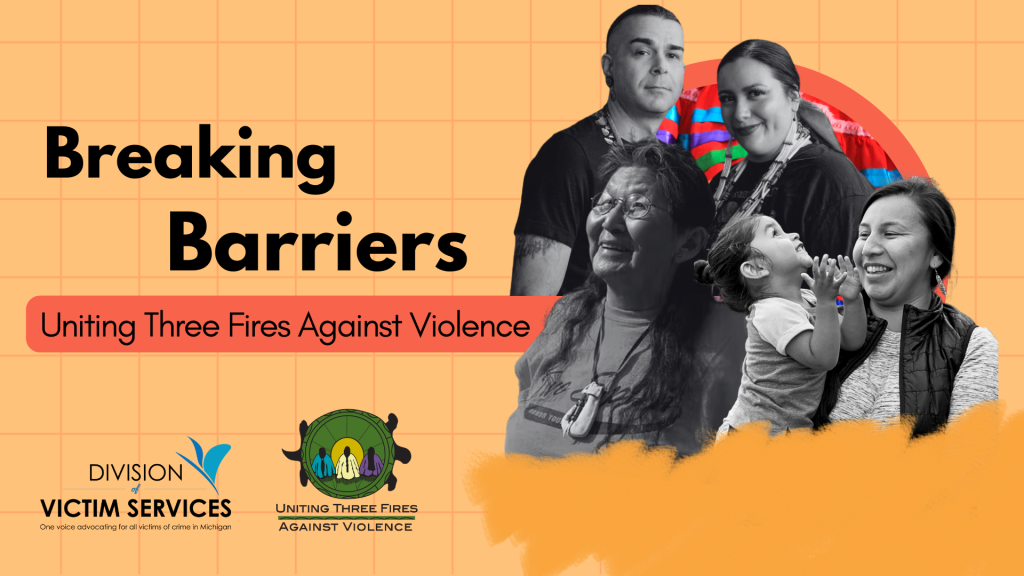
Uniting Three Fires Against Violence (UTFAV) created a cultural video series intended for individuals and communities across Michigan that may work with our Indigenous/Tribal/Native survivors who have experienced gender based violence. The videos spotlight how historical trauma continues to impact responses to violence against women living in and outside of their Tribal communities.

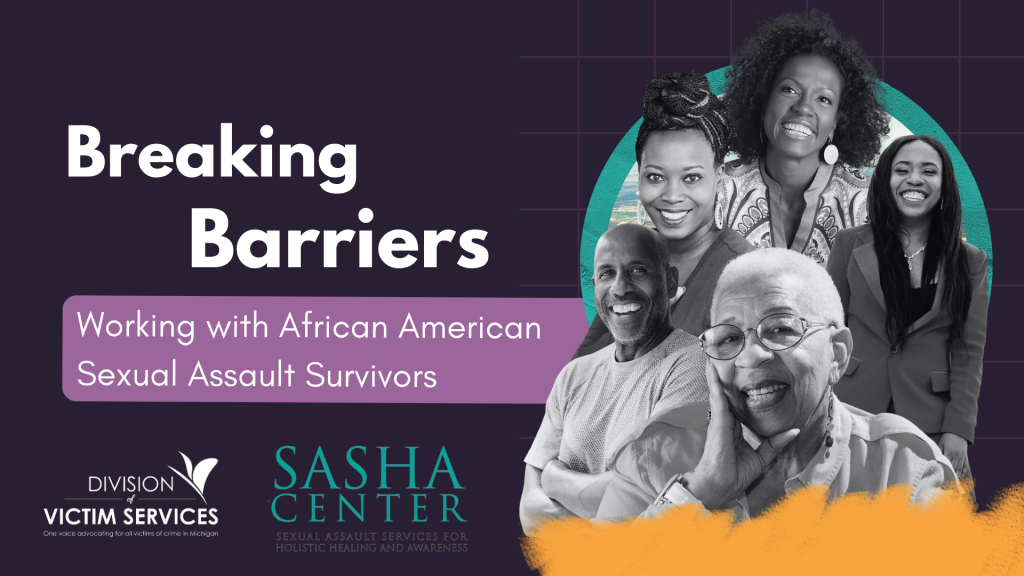
In this training, you will learn the importance of addressing anti-Blackness in mainstream organizations, how to use the SASHA Center Black Women’s Triangulation of Rape Model to identify systemic barriers experienced by African American sexual assault survivors, and strategies for ensuring services and settings are culturally honoring.

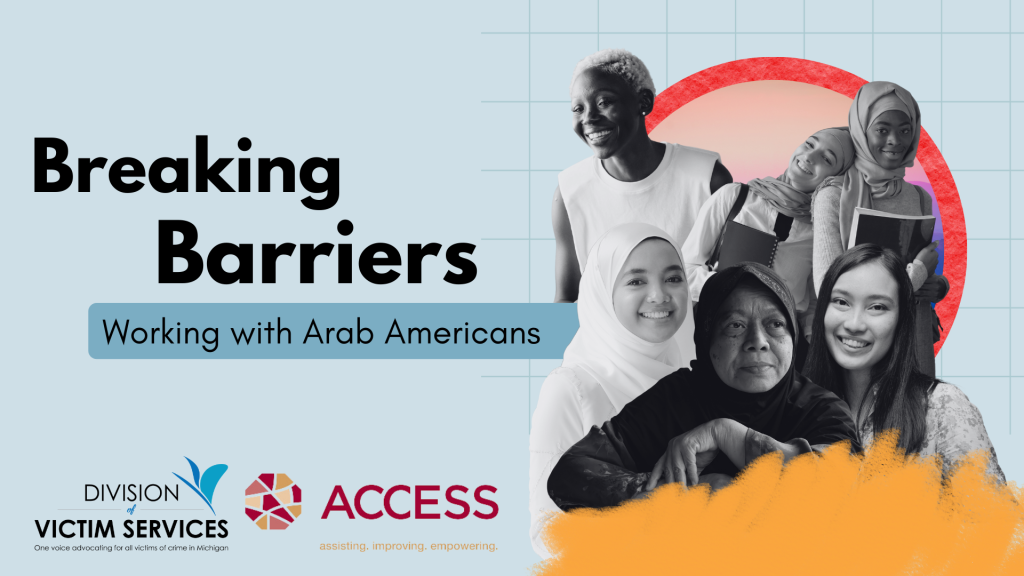
This training was developed and presented by the Arab Community Center for Economic and Social Services. ACCESS is the largest nonprofit Arab American human services agency in the U.S. In this training, you will learn more about the experiences of Arab American individuals, barriers experienced by Arab American individuals, and strategies for addressing barriers experienced by Arab American individuals

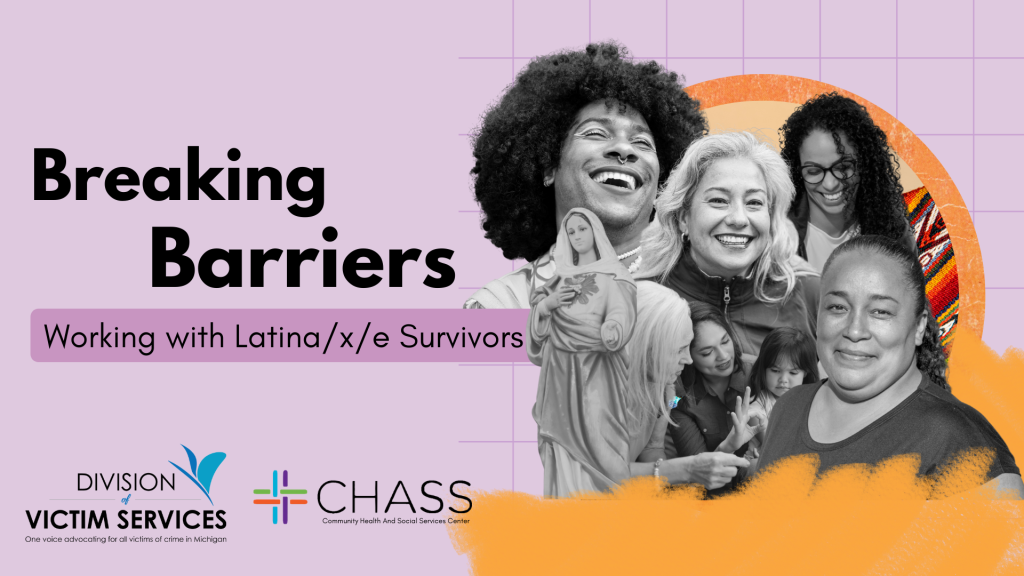
LA VIDA works to eradicate domestic violence and sexual assault in Southwest Detroit and Southeast Michigan. In this training, you will learn more about the experiences of Latina/x/e survivors, barriers to help seeking and engagement experienced by Latina/x/e survivors, and strategies for addressing barriers experienced by Latina/x/e survivors.

In this training, you will learn more about the experiences of individuals with intellectual and developmental disabilities (I/DD), barriers experienced by individuals with I/DD, and strategies for addressing barriers experienced by individuals with I/DD

Meet the Team

Co-Director

Dr. Katie Gregory is is a Professor of Ecological-Community Psychology at Michigan State University and the Co-Director of the Michigan Victim Advocacy Network (MiVAN), funded by the Michigan Department of Health and Human Services, Division of Victim Services. Dr. Gregory’s research examines how medical, legal, and social service systems respond to survivors of sexual assault and more broadly, survivors of gender-based violence. Most recently, Dr. Gregory is a co-investigator for a National Sexual Assault Kit Initiative (SAKI) funded project through the Michigan State Police, examining a community’s SAKI team response, including the re-opening, re-investigation, and decision to prosecute cases related to previously untested rape kits.

Co-Director

Abby Wattenberg, MSSA, is Co-Director of the Michigan Victim Advocacy Network (MiVAN).  In this role, she oversees outreach and evaluation, with a focus on translating research findings into understandable, accessible, and actionable data for community partners.  Abby has been the project lead on a training series to bring the expertise of Michigan organizations serving underserved and historically marginalized populations to crime victim advocates statewide.  This training series, called “Breaking Barriers,” addresses the challenges faced by survivors and offers advocates strategies for providing culturally-honoring, trauma-informed support. 

Apryl E. Pooley, PHD – Director of Training and Technical Assistance

NiCole Buchanan, PHD – Faculty Advisor and Trainer

Emily Sheridan-Fulton, M.A. – Outreach and Evaluation Specialist

Alex Reeves – Digital Media Manager/Communications Coordinator

Claire Nussdorfer, M.A. – Technical Support